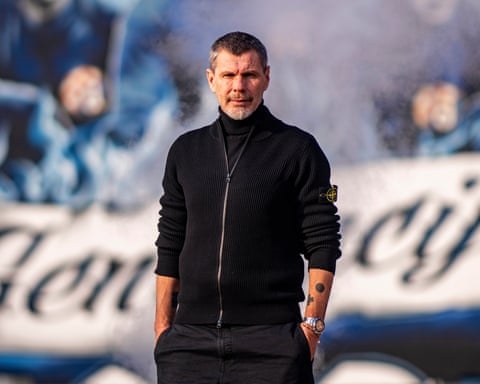
The mist settles over the Maksimir Stadium, softening the sharp lines of its stands. Inside a nearby building, now serving as the club canteen, Zvonimir Boban reflects on his return. The very spot where he once slept as a youth player now hosts a conversation over a meal. “Emotionally, this is the greatest story of my life,” he states. “Where else would I be?”
His journey through football administration has been notable but brief. Over the past decade, his roles at FIFA and UEFA left a significant mark on the sport. Nearly two years after his high-profile departure from UEFA, many expected him to pursue another major position. Instead, he has chosen a different path.
His world has both contracted and expanded. The executive influence he held in Zurich and Nyon is gone, replaced by the intense scrutiny that comes with leading Dinamo Zagreb. Recent press critiques following a European defeat illustrate the challenge. “They crucified Jesus, and he was a better man than any of us,” he remarks. “So who are we to expect anything less in daily life?”
That rhetorical style is characteristic of the man who returned six months ago, first as CEO and then, following a democratic election in September, as president. His mission is to revitalize a club still recovering from past scandals, and he is undertaking this task without a salary.
“My entire life, I’ve spoken of my love for this club, this city, and my country,” he explains. “When the opportunity came to serve, could I really say no? To refuse would have been a betrayal of everything I believe in.”
Naturally, the conversation turns to his exit from UEFA in early 2024, following a disagreement over proposed statute changes. “I regret the personal rift with Aleksander [Ceferin]; we had a good relationship,” he says. “But I did what I felt was necessary. I thought it through carefully. Everyone lives with their decisions.”
He suggests he would likely still be at UEFA had that conflict not arisen, just as an earlier, principled stance led to his departure from AC Milan. This consistency raises a question: how would he have responded to recent controversies at FIFA, where he once served as deputy secretary general?
He remains proud of the work done to reform FIFA, particularly the implementation of VAR, which he argues has bolstered the game’s integrity. However, he is sharply critical of recent actions by FIFA President Gianni Infantino, specifically referencing the awarding of a “peace prize” to a former world leader during a World Cup draw.
“It was disrespectful and irresponsible,” Boban states. “I couldn’t watch it. The focus has shifted from football to politics, which is a shame. He may intend well, but the effect is the opposite. It’s a shame for FIFA and for football itself.”
Back in his office, the discussion shifts to Dinamo’s future. He has brought in Albert Capellas, formerly of Barcelona’s academy, to overhaul the youth system. The goal is to create one of Europe’s premier football schools, producing well-educated players. He believes Dinamo can become a strategic destination for young talents from major leagues needing competitive experience, citing recent transfers as evidence.
His vision is compelling, but can such a model truly compete in today’s football landscape? “I believe, in time, we can,” he insists, pointing to clubs like Atalanta as examples of success through intelligent management.
He avoids direct criticism of UEFA’s new competition formats, which he feels were well-executed, though he notes his own role in shaping the final Champions League model. His critique is reserved for the expanded Club World Cup. “Thirty-two teams over 30 days is too much; it’s killing the players,” he argues.
As the conversation deepens, covering topics like the physical toll on modern players, one wonders if football has lost a vital voice in its governance. With UEFA’s presidential election approaching, some might see him as a candidate. He dismisses the idea entirely.
“No, this is it,” he says firmly. “This was my first real station in football, and it will be my last. It’s the one I love most. What else could there be?”
Outside, the fog has fully enveloped the pitch. It was here, in May 1990, that Boban’s flying kick at a policeman during a riot made him a symbol of Croatian defiance. He downplays his role. “It was a collective moment of youth reacting to injustice, seeking freedom. The real heroes are those who fought in the war. It was never about nationalism, but about justice.”
Long before his football career, Boban studied history. What did he learn? “That people don’t change much. Our surroundings and tools change, but the ancient Greeks had the same fears and doubts we do today.”
Ultimately, he remains unchanged at his core. “You can read a million books, but in my soul, I am a football player,” he says.
He still occasionally laces up his boots to train with the academy’s younger teams, his knees protesting but his spirit willing. “I’m just the joker in training now,” he smiles. “But since I was a child, I felt my mission was to play football. And in the best part of my heart, I’m still that kid.”