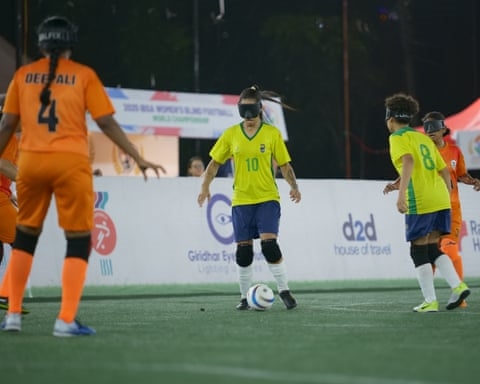
A new national team is breaking barriers and reshaping lives in Brazilian sport. Formed just last year, the women’s blind football squad has already made its mark on the international stage, finishing fourth at the recent world championship. For its players, the journey represents far more than athletic achievement.
The team’s motto, “We are the first, but we will not be the last,” captures its pioneering spirit. One midfielder, who began playing after losing her sight to a hereditary condition, describes the sport as a lifeline. “It pulled me out of a very difficult place,” she says. “It gave me a new perspective and new dreams.” Her decisive goal in the tournament opener was a milestone for both her and the fledgling program.
The squad’s rapid ascent is notable given its unconventional assembly. With no domestic league to draw from, players were initially identified through video submissions. The goalkeeper, one of the few sighted members, recalls her abrupt introduction to the unique demands of the sport, where verbal guidance is as crucial as physical skill. “I had to learn everything anew,” she notes. “It’s about far more than just stopping the ball.”
The team’s emergence follows a long history of exclusion. Blind football has been played in Brazilian schools for decades, often with improvised equipment. While the men’s game was formalized and became a Paralympic powerhouse, a women’s national side only became official in 2025. Experts point to a dual barrier of gender and disability prejudice that delayed investment and organization for years.
“Football was institutionalized as a male domain from its modern origins,” explains a researcher studying gender in sport. “Women were long cast in supporting roles. This social division extended into public life and sports institutions.” For women with visual impairments, the lack of visibility and structure meant opportunities were virtually nonexistent.
The current cultural shift in women’s football, bolstered by the prominence of star players, has helped create a more receptive environment. With major tournaments on the horizon, the focus is on building a sustainable future for the program. The players themselves balance training with studies and work, often without financial compensation, driven by a deeper purpose.
The impact transcends wins and losses. It’s about representation and possibility. “When someone like me is on that field, it sends a message: ‘I am here. I am visible. I am a respected athlete,’” the researcher emphasizes. For the midfielder, the goal is to strengthen the foundation for those who follow. Her advice to others facing vision loss is simple: “Sport is here to embrace us. I hope it can do for others what it did for me.”
As this trailblazing team continues its journey, it is not only competing for titles but also challenging perceptions and opening doors for a new generation of athletes.