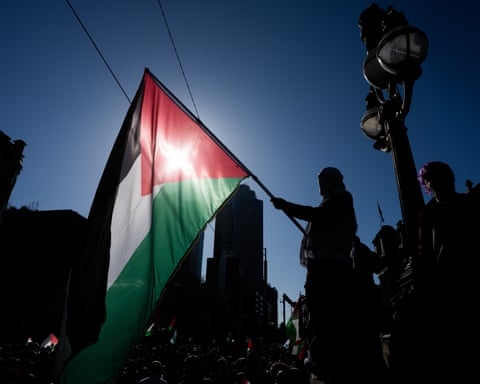
A proposal to outlaw the slogan “globalise the intifada” has ignited a fierce debate in New South Wales, pitting free speech concerns against public order and security arguments.
The state’s premier has described the phrase as “hateful, violent rhetoric,” directly linking its use to recent tragic events. The government’s move forms part of a broader legislative push to restrict hate symbols and speech.
The slogan has become a focal point in international discourse, with authorities in the United Kingdom making arrests related to its use, and political figures in the United States pressured to define their stance on it.
The term “intifada” is an Arabic word meaning “uprising” or “shaking off.” It is historically associated with two major periods of Palestinian resistance against Israeli occupation: the first, from 1987 to 1993, and a second, more violent conflict from 2000 to 2005.
Proponents of the slogan argue it represents a legitimate expression of solidarity. An organiser for a Palestine action group stated it signifies support for “the uprisings of Palestinians against their oppression.” An academic expert in Middle Eastern studies warned that banning terms rooted in a community’s language and history can be perceived as an attack and deepen social divisions.
Conversely, many within the Jewish community and associated experts view the phrase as an explicit endorsement of violence and terrorism. One director of a Jewish civil organisation labelled it “offensive” and “threatening,” while a hate speech monitor asserted the phrase is “anti-peace, pro-violence, and specifically pro-terrorism,” with no acceptable context for its use.
Legal scholars have raised significant concerns about the precedent of criminalising phrases with deeply contested meanings. A university expert on hate speech cautioned that such a ban risks problematic legal interpretations and likely court challenges, arguing it is dangerous for the state to “lock in a particular interpretation of a contested phrase.”
The specific mechanism for banning the slogan remains unclear, as initial legislation did not include the provision. A parliamentary committee is set to further examine “hateful statements,” with more detailed laws expected next year.
The controversy underscores the complex challenge of balancing community safety, the perception of threatening language, and the protection of political expression in a deeply polarised climate.