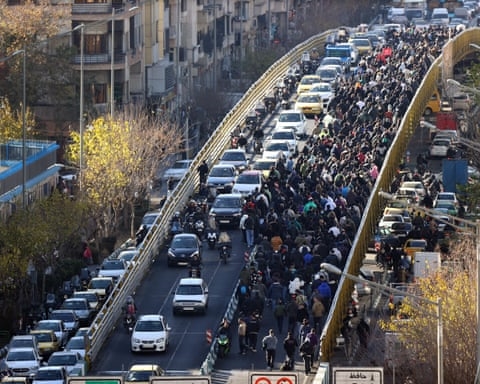
In response to the largest wave of public demonstrations in three years, Iran’s government has announced its intention to engage in talks with protest leaders. The unrest, which began this week, was triggered by a severe economic crisis marked by a record devaluation of the national currency and rapidly declining living standards.
The protests erupted after the Iranian rial plummeted to an unprecedented low against the U.S. dollar, prompting widespread closures of businesses in Tehran’s commercial center. The dissent quickly spread from the capital to other major urban centers. Public gatherings featured chants for freedom and unity, while security forces deployed tear gas to disperse crowds.
This represents the most significant domestic challenge since the nationwide protests following the death of Mahsa Amini in 2022. In a notable shift, President Masoud Pezeshkian has now directed the government to address what he termed the “legitimate demands” of the populace. Officials stated that a formal mechanism for dialogue would be established.
In a public statement, the president emphasized that the economic welfare of citizens was a paramount concern, pledging actions to reform monetary policy and protect purchasing power. Analysts observe that the administration has recently adopted a less confrontational domestic approach, possibly to consolidate public support following regional conflicts. There have been reports of a more relaxed enforcement of certain social regulations in the capital.
The economic data underpinning the crisis is stark. Official statistics indicate that food prices have surged by over 70 percent in the past year, with the cost of medical supplies rising by half. The government’s announced plans to raise taxes in the coming new year have further fueled public anxiety.
The head of the central bank resigned this week as the currency crisis deepened, with the rial having lost nearly seventy percent of its value since he took office. The collapsing currency has made basic necessities increasingly unaffordable for ordinary Iranians.
While grappling with domestic turmoil, the government also faces external pressures. A former U.S. president recently issued a warning about potential military action if Iran were to resume certain nuclear activities, allegations that Iranian officials have firmly denied. Iran’s foreign policy leadership has reiterated a call for diplomatic engagement based on mutual interests.
The unfolding situation presents a critical test for the Iranian leadership, balancing internal economic distress and social discontent against a complex international backdrop.