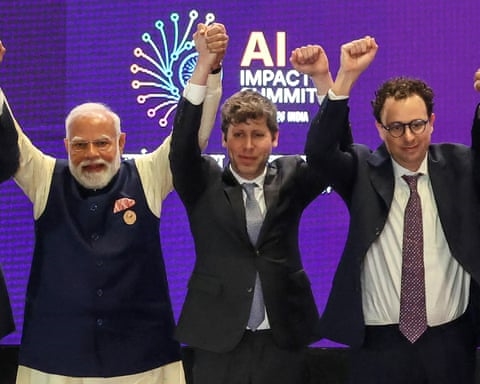
A major technology summit in New Delhi has spotlighted India’s urgent drive to integrate advanced artificial intelligence into its economy, with a clear preference for partnering with American tech giants over Chinese alternatives. The gathering underscored a strategic alignment between India’s growth objectives and the United States’ geopolitical and commercial interests in the AI sphere.
Indian leadership framed the adoption of AI as a transformative moment for the nation, essential for accelerating development and improving the lives of its 1.4 billion citizens. This ambition dovetails with the agenda of leading U.S. AI firms, which used the summit to announce expanded access to their flagship AI models within India.
The backdrop to this collaboration is intense global competition, particularly with China. U.S. officials at the event framed the choice starkly, suggesting alignment with American technology is a path to sovereignty and security, while implicitly casting alternatives as risky. A recent bilateral technology agreement has further cemented this partnership, aiming to bind India’s digital future closer to U.S. ecosystems.
Analysts present highlighted the staggering potential economic impact. Some projections suggest AI could one day manage the majority of global economic output, revolutionizing sectors from healthcare to infrastructure. For a developing nation like India, the promise is a dramatic leap in productivity and living standards.
However, the path is fraught with challenges and critical questions. India currently lacks the domestic semiconductor manufacturing and massive data center infrastructure required for technological independence. This creates a dependency, raising concerns about long-term control and cultural influence. Critics warn that over-reliance on foreign AI models could lead to a form of digital colonialism, eroding local culture and autonomy.
While U.S. companies and officials publicly emphasize cooperation and partnership, some observers caution that the underlying business model—capturing vast user bases—could create deep-seated dependency. The summit concluded with warnings about the risk of a global AI monoculture, where a handful of dominant models shape economies and societies worldwide, potentially diminishing human diversity.
India’s strategy appears to be a calculated gamble: embrace American AI to fuel immediate growth while attempting to negotiate terms that preserve its cultural identity and some measure of control. The nation is also investing heavily in building its own long-term capacity. The outcome of this high-stakes technological embrace will significantly shape not only India’s future but the global balance of power in the AI era.