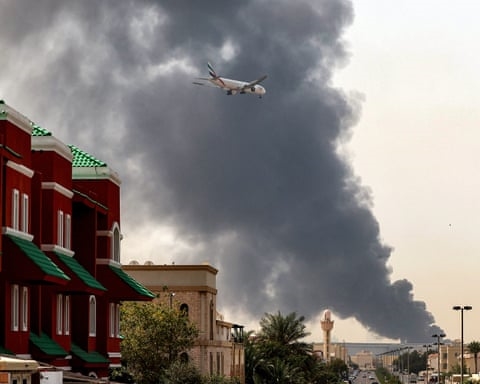
For over a fortnight, the skies over the Gulf have become a highway for munitions, marking a dangerous new chapter in a conflict that regional capitals had desperately worked to avert. The escalating exchange of fire is now directly targeting critical energy installations, signaling a perilous shift that threatens the very foundations of regional stability.
This development strikes at the heart of a decades-long strategy employed by Gulf nations. Their blueprint for security and prosperity was built on a triad of principles: unwavering reliance on American military protection, cautious diplomatic outreach to Tehran, and the gradual normalization of economic relations with Israel. The current crisis has exposed the fragility of each pillar.
The strategic waterway of the Strait of Hormuz is effectively closed, crippling a vital global artery. Soaring insurance premiums and rerouted vessels are strangling port activity from Jebel Ali to Doha. Aviation hubs, central to connecting continents, are seeing flights diverted en masse. This economic disruption arrives at a critical juncture, as ambitious national visions from Riyadh to Abu Dhabi—predicated on attracting global investment, tourism, and technology—are fundamentally reliant on a reputation for safety and predictability.
Simultaneously, the limits of depending on an external security guarantor are laid bare. While US military assets remain pivotal to regional defense, Washington’s strategic decisions are made according to its own calculus. The immediate fallout—missiles over cities, threats to infrastructure, economic paralysis—is borne disproportionately by the Gulf states themselves.
Recent diplomatic efforts to de-escalate tensions, including direct dialogue with Iran, now appear insufficient. These nations find they cannot firewall themselves from a confrontation whose primary drivers are external. Furthermore, the political landscape, shaped by ongoing conflicts elsewhere in the region, constrains how openly these governments can align with certain war objectives without significant domestic backlash.
The immediate imperative is clear: prevent further attacks on energy and civilian infrastructure. However, the greater strategic dilemma lies in managing the conflict’s conclusion. A protracted war promises only sustained volatility. Conversely, a severely destabilized Iran does not equate to security, potentially leading to greater fragmentation and unpredictability.
This crisis underscores a persistent vulnerability: despite extensive diplomatic and economic hedging, the Gulf remains acutely exposed to conflicts ignited beyond its borders. While enhanced regional defense cooperation, such as integrated air shields and maritime coordination, could mitigate some risks, lasting stability remains elusive. It is tied to unresolved political conflicts that continue to fuel cycles of violence across the Middle East. The ultimate challenge is not merely to halt the current escalation but to diplomatically shape an outcome that avoids a new, enduring, and even more dangerous era of regional disorder.