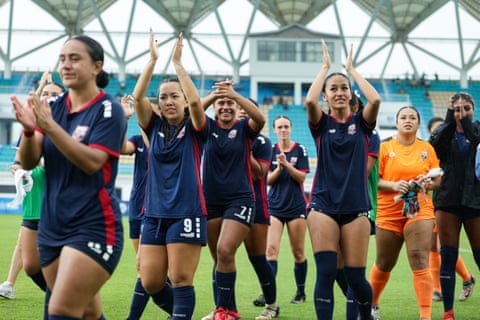
In the vast landscape of international football, some stories are written by giants. Others are forged by the unlikeliest of heroes. The American Samoa women’s national team is authoring a chapter that belongs firmly in the latter category, transforming a legacy of defeat into a stunning campaign for World Cup qualification.
Just over a year ago, the notion of American Samoa competing in the final round of Oceania’s World Cup qualifiers seemed fanciful. Ranked 153rd globally, the team from the tiny Pacific island nation was an afterthought in a confederation of underdogs. Their history was marked by a record-setting 21-0 defeat decades ago. Yet, through a series of seismic upsets, they have shattered every expectation.
The turnaround began in a preliminary tournament last November. Facing Tonga, the highest-ranked team in their group, American Samoa delivered a stunning 3-0 victory, sparked by an 18-year-old, Cassidy Drago, who scored the nation’s first-ever Women’s World Cup qualifying goal. A follow-up win against Cook Islands sealed their improbable advance to the next round.
There, the fairy tale only grew. Confronting the Solomon Islands, champions of the Pacific Nations Cup and ranked 80 places higher, American Samoa secured a legendary 1-0 victory—a result that sent shockwaves through the qualifying process. A subsequent win against neighboring Samoa last month cemented their place among Oceania’s final four contenders, completing what team captain Alma Mana’o describes as a journey “from underdog to dark horse.”
Central to this resurgence has been the influence of head coach Amanda Cromwell, a 1996 U.S. Olympic gold medalist. Since her appointment, the team has secured four wins in five matches. Players credit her with instilling a new professional standard, from coordinated training camps to structured nutrition plans—a level of support previously unheard of for the program.
“The foundation she has built is everything,” Mana’o stated. “This new standard isn’t just for now; it’s the benchmark for the future of football here.”
The team’s culture, deeply rooted in familial bonds, has been a driving force. The squad features multiple sets of sisters, and the Mana’o family itself holds a unique record for the most family members to participate in FIFA events. “We are a family on and off the pitch,” Mana’o emphasized. “We hold each other accountable, we push each other, and that unity is our strength.”
For Mana’o, who debuted for the national team as a 15-year-old in an 8-0 loss, witnessing a new generation of teenagers enter the setup and experience immediate success is particularly poignant. “To see 14-year-olds like Mia and Naiyah coming in and having positive, winning experiences from the start… it’s incredible,” she reflected. “If my 15-year-old self could see us now, she would be overjoyed.”
The next challenge awaits in Auckland, where American Samoa will face Papua New Guinea. It is the same city where, 28 years ago, the team suffered its historic defeat. Now, they return not as participants, but as contenders, carrying the hopes of an entire nation and proving that in football, heart and unity can redefine any destiny.