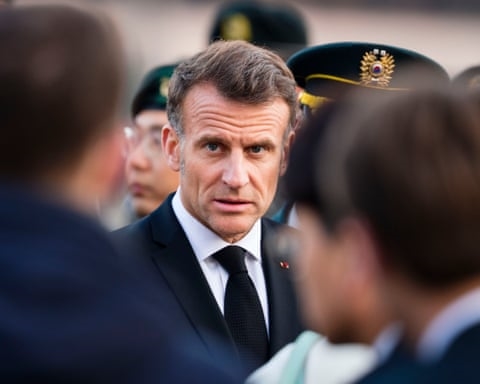
In a pointed address delivered during an official trip to Asia, the French President has issued a stern critique of what he described as volatile and contradictory foreign policy statements emanating from Washington. Speaking to reporters, he emphasized that international stability requires consistency and seriousness from global leaders.
“Excessive and erratic commentary undermines the very peace we seek,” the President stated. “This is not theater. The situation demands calm, stability, and a clear path toward de-escalation. To be taken seriously, one must demonstrate coherence, not publicly reverse positions daily.”
The remarks included a robust defense of the North Atlantic Treaty Organization, which has faced sustained questioning from U.S. leadership. The French leader argued that the alliance’s strength is built on unshakable mutual trust.
“Foundational alliances like NATO are defined by the unwavering confidence between members,” he explained. “Publicly casting doubt on core commitments each day erodes the essence of the pact itself.”
This intervention follows a series of conflicting signals from U.S. officials regarding both an ongoing international conflict and the future of the transatlantic alliance. In recent days, the U.S. President has made disparate claims about the conflict’s status, alternately suggesting victory was imminent, demanding allied military involvement, and encouraging unilateral action by other nations. Simultaneously, senior U.S. cabinet members have hinted at a potential reevaluation of Washington’s role in NATO, refusing to explicitly reaffirm the collective defense pledge.
The uncertainty has prompted planned diplomatic outreach from the alliance’s leadership to Washington, while European officials have rallied to NATO’s support. One Eastern European leader suggested that the combination of security threats and energy market turmoil appeared advantageous to Moscow.
Analysts note that while the rhetoric from the U.S. is not unprecedented, it introduces significant strain at a critical time. Legal hurdles in the U.S. would complicate any attempt to unilaterally abandon the alliance, which is legally bound to collective defense but not to offensive actions.
The conflict, centered on a key global oil transit route, has triggered economic repercussions worldwide, squeezing energy supplies and fueling inflation. Dozens of nations recently held virtual consultations focused on restoring maritime security through diplomatic and economic means, explicitly ruling out immediate military options.
“The process must be phased and can only begin once hostilities cease, and it requires dialogue with all involved parties,” the French President said, dismissing the feasibility of a unilateral military operation to reopen the vital waterway.
He further argued that military strikes, while potentially impactful in the short term, would not provide a lasting solution to underlying regional security issues, warning that without a diplomatic framework, tensions could quickly reignite.
In response to the heightened rhetoric, Iranian military officials issued a warning of “broader and more destructive” responses to any escalation, vowing to continue the fight. Meanwhile, Tehran has denied any direct negotiations with Washington, stating messages have only passed through intermediaries.
The U.S. President has asserted that military operations will intensify unless a settlement is reached, claiming strategic objectives are nearly met. The evolving situation leaves the Western alliance navigating one of its most publicly fraught periods in recent memory.