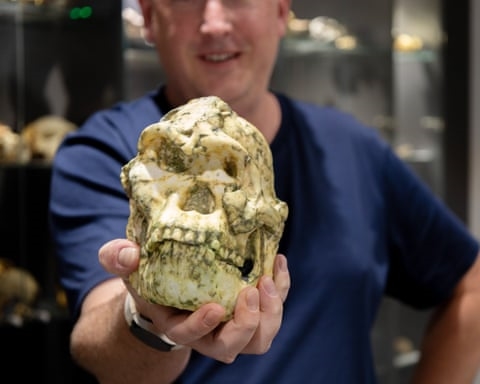
A remarkably complete ancient skeleton, known as “Little Foot,” may represent a previously unknown species of human ancestor, according to new scientific analysis. The findings challenge existing classifications and suggest a more complex picture of early human evolution.
The fossil, one of the most intact of its kind ever discovered, was painstakingly recovered over two decades from a cave system in South Africa. Since its full unveiling several years ago, experts have debated its precise place in the hominin family tree, with some attributing it to known species like Australopithecus africanus.
However, a recent study posits that the skeleton’s anatomical features are distinct from all previously identified species from the same region. Researchers point to specific traits in the base of the skull—an area that typically shows little evolutionary variation—as key evidence. Significant differences in this conserved region, they argue, are strong indicators of a separate species.
“The evidence suggests we are looking at a branch of the human family tree that had not been sampled before,” said one of the study’s lead researchers. “It’s remarkable to find such a signal in the most complete fossil of its kind.”
The research team has stopped short of formally naming a new species, noting that the honor should likely go to the scientists who dedicated years to the specimen’s excavation and initial study. The debate also extends to the fossil’s age, with estimates varying by nearly a million years, adding another layer of complexity to its interpretation.
This analysis reignites fundamental questions about the diversity of early hominins in Africa and underscores how a single discovery can prompt a reevaluation of humanity’s deep ancestral past.