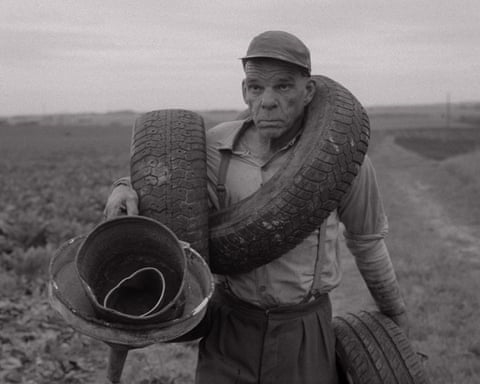
In a remote corner of southern Sweden, a man wages a solitary, consuming war against an invisible enemy. This is the quiet, compelling heart of John Skoog’s starkly beautiful black-and-white feature film, which transforms a simple premise into a profound character study.
The narrative centers on Karl-Göran Persson, a farmhand living in a rudimentary shack. His life is irrevocably altered with the arrival of a government pamphlet—a chilling manual for civilian conduct in the event of nuclear war. This document ignites a singular obsession within him. With meticulous, almost sacred dedication, Persson embarks on a mission to convert his humble dwelling into a fortified shelter, or “redoubt,” intended as a communal refuge for a catastrophe he prays will never come.
Driven by a pensioner’s modest income and relentless scavenging, he expands and reinforces his structure, layering wood and metal against an unspecified threat. The film’s pacing is deliberate, mirroring the protagonist’s methodical labor and inviting contemplation. Persson exists in a liminal space within his community: a figure of curiosity to local children and a target for occasional bullies, yet neither fully integrated nor entirely ostracized. Scenes of his peaceful interactions with villagers complicate the easy assumption that his project is born purely from loneliness. The fortification seems as much a bulwark against existential dread as it is against any physical danger.
The magnetic force of the film is its lead performance. The actor embodies Persson with a raw, physical vulnerability and an eccentric, childlike focus that is utterly captivating. In moments of respite, he showcases unexpected talents, from playing the accordion with poignant sincerity to displaying a peculiar, gentle command over the farm’s poultry. His presence transforms the screen, making every quiet gesture resonate.
While the plot’s trajectory is more atmospheric than narrative-driven, a subtle shift occurs. The relentless construction, initially seeming like a futile exercise, gradually accumulates a different meaning. The film subtly posits that the value of the redoubt may not lie in its intended purpose, but in the act of its creation itself—a tangible, defiant response to the formless anxieties of the modern world. It is a haunting, visually striking meditation on preparation, purpose, and the strange architectures we build for our survival.