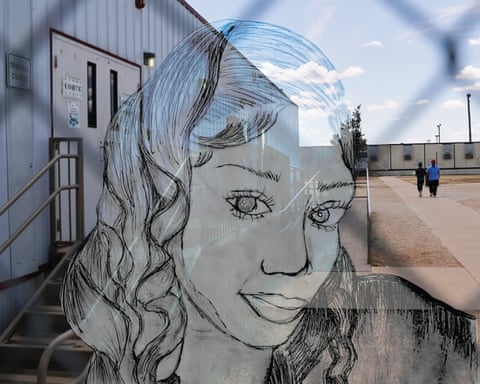
For a young woman held in a federal immigration facility in Texas, time has lost all meaning. Each day stretches into an unbearable eternity, marked by isolation, fading hope, and the physical toll of confinement.
The detainee, a 19-year-old asylum seeker from the Democratic Republic of the Congo, has spent over four months at the Dilley processing center. She describes her existence as a waking nightmare from which she cannot escape. “Another day passes, another night comes,” she said. “And sometimes I feel that this nightmare is not going to end.”
Her ordeal began when she was apprehended with her mother and younger siblings late last year. While her family was eventually released, she, now a legal adult, was separated from them and shuttled between multiple detention centers before arriving at Dilley. She recalls being forced to wear shackles and an orange jumpsuit, and the profound cold of one facility, which she calls “the fridge,” where officials confiscated her coat.
Now housed in a unit with hundreds of other single adult women, her days follow a grim routine. She wakes early for a sparse breakfast before retreating back to bed, often rising later with a headache. Her vision has deteriorated as her contact lens prescription has expired, with no access to an optometrist. The harsh fluorescent lights of the facility compound the strain. She has lost a significant amount of weight, citing a lack of appetite and poor-quality food.
A mental health evaluation conducted as part of her immigration case documented symptoms consistent with post-traumatic stress and major depression. The psychological strain is compounded by uncertainty; despite having an active appeal on her asylum case, she reports that officials have repeatedly approached her with deportation orders to sign, orders that are not legally valid while her appeal is pending.
A fleeting moment of joy came weeks into her detention when, by chance, she discovered her mother and siblings were being held in another section of the same vast center. After a tearful reunion, they were granted limited visitation. However, that relief was short-lived. Her family was released in March, leaving her alone once more. “The day after that was the saddest,” she said. “I didn’t know when I’d be able to see them again.”
With her family gone, the emptiness has grown. She spends afternoons in her shared room, often watching television with her Spanish-speaking roommate. She has withdrawn from activities, fearful of injury and wary of the facility’s medical care. Most of the few friends she made have been released. “As time went by, people were leaving, and I started to lose my mind,” she explained. “Basically, I stopped doing things.”
She also endures racial hostility from other detainees, who have made derogatory comments about her hair. In one disturbing incident, when her roommate fell ill, others warned her she would be blamed if the girl died simply because she shared a room with a Black person.
Her connection to the outside world is a source of both comfort and pain. Video calls with her family are a lifeline, but conversations with old friends in Maine highlight how her life has been put on hold. A friend is having a baby shower she cannot attend. She herself should be starting a career as a nurse’s assistant, a path toward her dream of working with children.
Her only concrete plan for the future is a simple one: to return to a favorite coastal spot in Maine, have an ice cream, and be in nature again. For now, she waits, staring out at Dilley’s beige landscape of dorms and trailers, with no clear end in sight. Her asylum appeal could take a year to resolve, a span of time that feels both interminable and impossible to bear.
The conditions at facilities like Dilley have drawn sharp criticism from medical professionals and human rights advocates, who have cited evidence of psychological harm and due process violations. Authorities have consistently defended their practices, stating that detention is a consequence of individual choice and encouraging those without legal status to arrange their own departure.