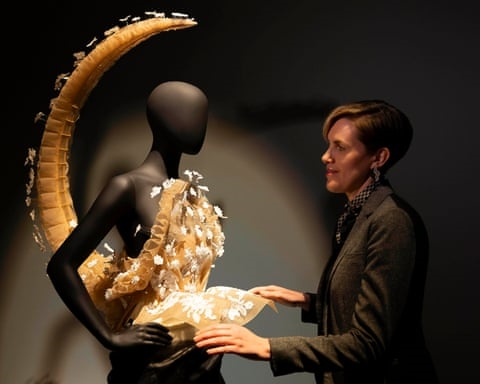
A new exhibition in London plunges visitors into the fantastical and provocative world of Elsa Schiaparelli, the Italian designer who treated fashion as a canvas for surrealist wit. The display is less a retrospective of garments and more an immersion into a vibrant, intellectual salon of 1930s Paris, populated by the creative spirits who were her collaborators and contemporaries.
From buttons shaped like gilded elephant trunks to dresses adorned with external skeletal ribs, the presentation argues compellingly that Schiaparelli was not merely a couturier who mingled with artists, but a bona fide artist herself. Her work consistently subverted expectation: a hat transforms into a shoe, a compact mirror mimics a telephone dial. This was clothing designed to intrigue and amuse, to engage the mind as much as the eye.
Her legendary collaborations are presented as true creative partnerships. Alongside the iconic lobster dress, famously worn by Wallis Simpson, sits Salvador Dalí’s lobster telephone—a testament to their shared visual language, with the dress predating the sculpture. Correspondence from Dalí displayed next to the groundbreaking skeleton dress explicitly credits Schiaparelli with the core concept of “bones on the outside.”
Born in Rome in 1890, Schiaparelli’s unconventional perspective seemed innate. Her own memoirs recount a childhood attempt to plant flower seeds in her own ears and mouth, hoping to cultivate personal beauty—an early, if unsuccessful, foray into bodily transformation. She launched her career in Paris as a divorced mother, initially with a line of trompe l’oeil knitwear that played visual tricks. Her rapid ascent was marked by a love for “shocking pink,” which became her signature, and a flair for theatricality that saw a taxidermied pink polar bear grace her boutique.
The exhibition also bridges the decades, seamlessly integrating contemporary pieces from the house’s current creative director, Daniel Roseberry. His designs, such as a golden lung-shaped breastplate and ensembles incorporating deconstructed technology, demonstrate a clear lineage—capturing the original spirit of humor, glamour, and deliberate oddity without descending into pastiche.
Ultimately, the showcase poses a fundamental question about the nature of fashion. It makes a vigorous case for clothing as a serious, collaborative, and culturally engaged art form. For those who believe fashion should challenge and converse, the exhibition is a thrilling validation. For everyone else, it is, at the very least, an unforgettable journey into a world where nothing is quite as it seems.