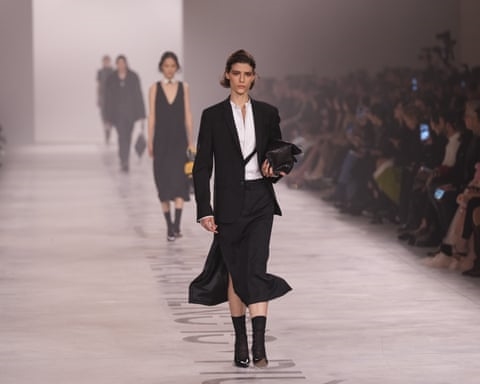
MILAN — The spotlight at the opening of Milan Fashion Week fell not on a single star, but on a chorus. Maria Grazia Chiuri, making her highly anticipated debut as creative director of Fendi, unveiled a collection that framed her arrival not as a solo act, but as a continuation of a legacy.
The catwalk itself set the tone, emblazoned with a new directive: “Less I, more us.” Backstage, Chiuri articulated this as a tribute to the house’s deep-rooted matriarchal history and an Italian philosophy of collaborative creation. “It’s about the feminine approach to fashion,” she explained, “rooted in shared ideas, artisanal skill, and creative liberty.”
Her appointment marks a significant moment for the Roman maison, historically steered by generations of the founding family. Chiuri, however, who began her career in Fendi’s accessories studio decades ago, positions herself as a custodian of its heritage. Yet, her first show unmistakably carried the imprint of her own design ethos—one that prioritizes relevance and wearability.
Gone were overtly luxurious tropes. In their place was a wardrobe built for contemporary life: an oversized black blazer, mirroring the one Chiuri wore herself, paired with relaxed tailoring, trench coats over jeans, and cargo pants styled with trainers. Practicality was key, with models often carrying two bags—a polished handbag alongside a roomy tote—evoking the reality of a daily commute.
Addressing Fendi’s foundational identity as a furrier, Chiuri presented a considered approach. The runway featured only archival pieces, and the house announced a new service dedicated to repurposing vintage furs, emphasizing durability and craft over new material. “Fur speaks to the softness and sensuality inherent to Fendi,” she noted.
The collection also paid homage to another pivotal figure in Fendi’s history: Karl Lagerfeld. Hired in 1965, he infused the brand with a radical, modernizing energy. Echoes of his influence were seen in stark, starched white collars on eveningwear and in scarves boldly printed with a “5 SISTERS” slogan, a nod to the founding generation.
Unsurprisingly, accessories played a central role. Chiuri, who co-designed the iconic Baguette bag in the 1990s, reimagined the classic with new exuberance, featuring elaborate beading and vibrant animal prints. Its prominence signals a strategic revival for the signature style.
In a recent interview, Chiuri reflected on the different perceptions of commercial success in fashion, observing that achievements by women designers are often labeled differently than those of their male counterparts. Her Fendi debut, however, focused less on individual critique and more on building a collective narrative—one that honors a storied past while dressing the multifaceted woman of today.