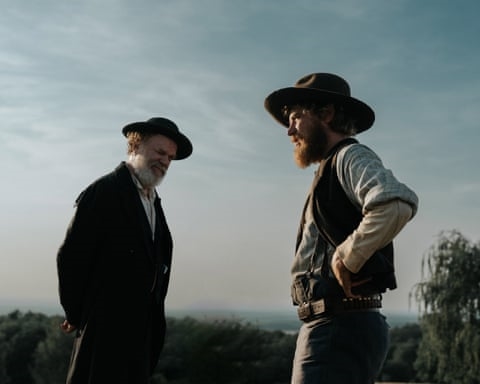
A somber, visually striking drama set in the American frontier ultimately feels hollow, its promising premise stretched thin over a feature-length runtime. The film, an adaptation of a novel, follows a community grappling with a terrifying outbreak, but struggles to connect its arresting imagery to a compelling emotional core.
The story unfolds in a remote Wisconsin town in the 1870s. Jacob, portrayed by Johnny Flynn, is a man bearing dual, unofficial roles: the town’s moral compass and its keeper of the peace, haunted by his experiences in the Civil War. His quiet life with his wife and child is shattered when a traveler’s corpse is discovered. The town’s weary physician, played with gravitas by John C. Reilly, identifies the cause of death as diphtheria—a diagnosis that spells imminent disaster.
Faced with a creeping epidemic, the town’s leaders are paralyzed by a terrible choice. Instituting a quarantine seems futile, likely to cause a panicked flight that would spread the disease further. Yet ignoring the crisis is its own form of moral surrender. This debate, however, is soon rendered academic by the relentless advance of the sickness.
Jacob’s authority proves fragile against the tide of fear. The horror of the disease is compounded by the threat of a distant, spreading wildfire, whose hellish glow stains the sky—a possible manifestation of the community’s collective dread, or a reflection of Jacob’s own fractured psyche. As others fall ill, his own health remains curiously intact, leading to whispered suspicions about his role in the calamity.
While the technical craft is evident in the film’s atmospheric tension and stark compositions, the narrative fails to achieve a satisfying depth. Reilly brings a needed weight to his role, but Flynn’s performance, though compelling, seems to lack a definitive direction, leaving the central character’s anguish feeling underexplored. The result is a carefully constructed period piece that, despite its serious intentions and potent setting, delivers less impact than its grim premise suggests.