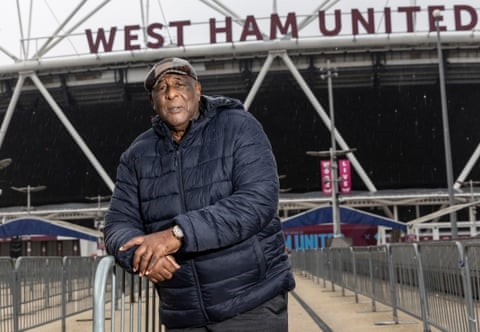
He was just 17 when he boarded a plane from Bermuda, his sights set on a trial in East London. For Clyde Best, it wasn’t a leap into the unknown filled with trepidation, but a clear-eyed grasp of opportunity. The year was 1968, and the parting words from his father, a naval officer, would become his guiding principle: he wasn’t playing just for himself, but for those who would follow.
Best’s journey is the story of a trailblazer who became a foundational figure for generations of Black footballers in England, navigating a landscape where hostility was often as prevalent as the roar of the crowd. His talent was undeniable. After impressing in Bermuda, where he was an international by 15, he arrived for his West Ham trial. A mix-up upon landing saw him stranded at West Ham station, fortuitously leading him to the home of John and Clive Charles, whose family provided a crucial anchor in a new country.
He passed the trial and soon found himself sharing a pitch with legends like Geoff Hurst, Martin Peters, and captain Bobby Moore, whom Best describes as a humble leader of the highest character. Under manager Ron Greenwood’s tutelage, Best’s powerful, skillful style flourished. He became a first-team regular, a prolific scorer, and part of a historic West Ham lineup in 1972 that fielded three Black players from the start—a first in English football.
Yet, his prowess on the pitch was met with vile racism from the stands. He endured relentless monkey chants, like those captured on film during a match at Tottenham. The abuse escalated to terrifying threats, including an anonymous letter promising an acid attack at Upton Park. In response, his teammates, led by Moore, formed a protective circle around him as they entered the pitch—a profound act of solidarity he still holds in awe.
Through it all, Best maintained a steadfast composure, driven by the responsibility he felt. He believed that retaliating would only hinder progress. His dignified resilience paved the way, with icons like Ian Wright and Viv Anderson later citing him as a seminal inspiration.
After seven seasons, seeking a new chapter, Best moved to the North American Soccer League in 1975, where he found success and even shared the field with Pelé. The Brazilian great, after a memorable friendly years earlier, had dubbed Best “the prince” to his “king”—a tribute that left the Bermudian walking on air.
Now 75, Best’s legacy is cemented not just by his goals, but by the burden he carried and the path he cleared. His story is a testament to the quiet strength required to change the game, both on the grass and in the culture that surrounds it.