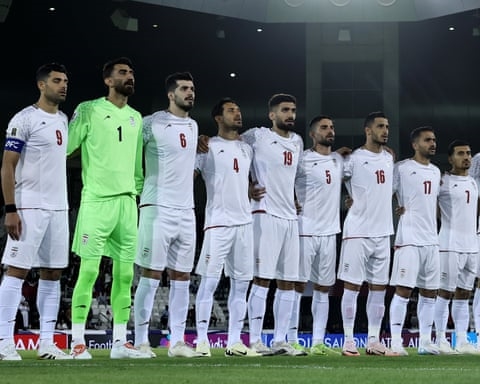
The status of Iran’s national football team for the upcoming World Cup remains shrouded in uncertainty, caught in a geopolitical crossfire that has spilled onto the sports field. Conflicting statements from political leaders and football authorities have created a volatile and confusing situation with just months until the tournament kicks off.
Recent days have seen a whirlwind of contradictory pronouncements. After initial reports suggested Iran might withdraw from the competition, subsequent communications from within the country indicated no final decision had been made, casting doubt on earlier declarations. This back-and-forth has left the football world in a state of limbo, awaiting a definitive resolution.
The core of the issue stems from heightened international tensions. Comments from U.S. leadership questioning the safety and appropriateness of Iran’s participation ignited a fierce response from Iranian football officials. They countered by suggesting the host nation itself should be stripped of the tournament, framing the remarks as an implicit threat.
Football’s global governing body, FIFA, now finds itself navigating a diplomatic minefield. Officially, its stated position is to ensure a safe and inclusive World Cup with all qualified teams present. The organization’s statutes strictly enforce political neutrality, making an involuntary exclusion of a team a scenario it is keen to avoid. Historically, FIFA has imposed bans for competitive infractions, but a politically-driven removal or withdrawal at this late stage would be unprecedented in the modern era.
The regulatory and competitive consequences of a potential withdrawal are severe. FIFA rules prohibit member associations from pulling out of its competitions post-qualification. Any team doing so would face significant financial penalties and likely be referred to a disciplinary committee, which could impose sporting sanctions such as exclusion from future tournaments.
Should Iran ultimately not participate, the question of a replacement becomes complex. Tournament regulations grant FIFA broad discretion to fill the vacancy, but the process is not clearly defined. While the next highest-ranked non-qualified teams from Asia are considered the logical candidates, any selection would carry its own political and sporting complications, especially given the current regional instability affecting travel and preparation.
The clock is ticking toward a resolution. FIFA has given itself a deadline in late April to reach a conclusion on the matter at its annual congress. Until then, the football community watches as a sporting spectacle becomes entangled in a high-stakes international dispute, with a team’s dream and the tournament’s integrity hanging in the balance.