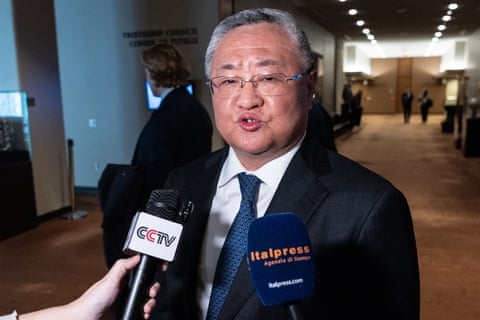
As international scrutiny focuses on the recent ceasefire announcement between the United States and Iran, one nation emerges with its diplomatic stature seemingly enhanced: China. Beijing is receiving widespread credit for its role in mediating the agreement, a narrative actively promoted within its state-influenced media.
Reports from international news agencies have highlighted China’s pivotal involvement in the eleventh-hour negotiations. This perception was bolstered by comments from the U.S. president, who acknowledged China’s influence in bringing Iran to the table. Domestically, Chinese outlets have framed this as evidence of the nation’s responsible global leadership during times of crisis.
However, regional analysts urge caution in overstating China’s influence. Some experts suggest the terms of the ceasefire, as presented, align so closely with Iran’s longstanding demands that persuading Tehran to agree required minimal effort. “Encouraging the regime to agree to it would have been like pushing an open door,” noted one analyst, pointing out that Iran made no significant concessions to enter talks and can tout the deal as a political victory.
Chinese officials have maintained a characteristically measured public stance, neither fully confirming nor denying their specific role. A foreign ministry spokesperson stated only that China consistently advocates for de-escalation and peace. Nevertheless, Beijing is likely content to be associated with brokering a deal that has temporarily averted a wider regional conflict.
This event fits a pattern of China seeking a larger diplomatic footprint in the Middle East. In recent years, it has facilitated dialogue between historic rivals and hosted talks for conflicting factions. Critics argue these efforts are often more about cultivating an image of a responsible global power than enacting substantive solutions. “These plans are geared to build a global image of Chinese responsibility… as opposed to being geared to actually solve the conflicts,” one analyst observed.
Despite its economic leverage as the largest buyer of Iranian oil, China’s direct diplomatic sway in the region remains limited. The relationship with Tehran, while economically significant, is not among Beijing’s deepest strategic partnerships. Furthermore, experts are highly skeptical of China’s willingness or capacity to act as a formal guarantor for any lasting peace. Such a role would require substantial diplomatic and military resources to enforce terms—a commitment Beijing appears reluctant to make.
“The cost would be extremely high,” said one Chinese academic. “Even if China were to act as a guarantor, it lacks the leverage to actually influence or control the parties involved.”
Beyond the public relations boost, practical economic interests underpin China’s desire for regional stability. A protracted conflict risks spiking global oil prices and triggering a recession, both of which would severely impact the export-dependent Chinese economy. Managing the crisis to stabilize energy markets remains a core national interest.
While the ceasefire marks a diplomatic opportunity for China, its long-term role as a Middle East peacemaker faces significant limitations. The nation may bask in the glow of a negotiation success, but transforming that into sustained, actionable influence presents a far more complex challenge.