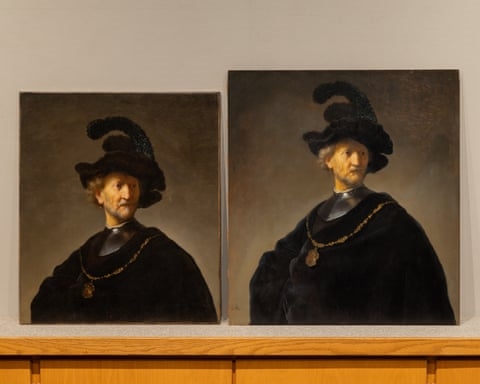
A portrait held in a private British collection, previously catalogued as a studio copy, has now been identified as an authentic work by Rembrandt van Rijn. The conclusion, presented by a prominent scholar, reunites the painting with its nearly identical counterpart, which has long been acknowledged as a masterpiece by the Dutch artist.
Both works, titled Old Man with a Gold Chain, date to the early 1630s and depict a similar elderly subject adorned with a gold chain and a feathered hat. The undisputed version, painted on panel, resides in the collection of the Art Institute of Chicago. Its companion, a slightly smaller canvas, has been loaned from a private UK collection where it was labeled as a workshop reproduction.
The reattribution challenges longstanding assumptions. The scholar argues that the technical execution and quality of the brushwork in the canvas are consistent with Rembrandt’s own hand. Historical context supports this view, as it was common practice for leading Dutch artists of the period to produce replicas of their successful compositions for different patrons.
Advanced technical analysis played a key role in the reassessment. While the Chicago panel shows evidence of compositional adjustments, the canvas version displays no such corrections, suggesting it was executed with confident precision. Furthermore, a separate scientific study found that the canvas support and pigment materials used in the UK-owned painting align with those documented in Rembrandt’s workshop during the relevant period.
The painting’s provenance adds to the intrigue. It was purchased as a Rembrandt in the late 19th century but was later downgraded to a copy in the early 20th century following the emergence of the Chicago panel. Its exhibition history has been sporadic, with attribution shifting over the decades.
The institution housing the acknowledged masterpiece has noted that, while its own review of technical data suggested a workshop origin for the canvas, scholarly debate on the authorship and purpose of such replicas remains active and evolving.
The current owner has expressed a longstanding appreciation for the work’s enigmatic status. Should the new attribution gain widespread acceptance, the portrait’s future would likely involve a permanent home in a public museum. The findings invite a renewed examination of other works historically categorized as copies, potentially reshaping parts of Rembrandt’s recognized oeuvre.