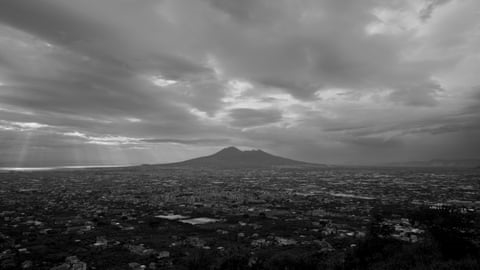
A new cinematic work offers a starkly different vision of Naples, one far removed from the sun-drenched, chaotic energy often depicted on screen. This film, the final part of a celebrated trilogy, immerses viewers in a city living under the constant, low-grade threat of the earth itself.
The director, an award-winning Italian filmmaker known for his poetic and immersive documentaries, spent four years in the Campanian capital. His previous films, one exploring the lives along Rome’s ring road and another focusing on the island of Lampedusa during the migrant crisis, have garnered top prizes at Europe’s premier festivals. For this project, he aimed to look beyond the postcard imagery.
“I began as a tourist in a beloved city,” the filmmaker explains, “but I sought to capture a Naples that is not immediately visible.”
The resulting film, shot entirely in black and white, strips away familiar icons. There is no pizza, no mafia lore, no vibrant street life. Instead, the city is rendered as an almost alien landscape, dominated by the ominous presence of the Campanian volcanic arc, which includes the legendary Mount Vesuvius and the restless Phlegraean Fields. This unsettling atmosphere is amplified by an experimental, otherworldly saxophone score.
A significant portion of the narrative unfolds in the control room of the Naples fire brigade, where operators field calls from anxious residents reporting tremors and shaking floors. The conversations reveal a populace in a state of suspended anxiety—some terrified, others almost impatient for a definitive catastrophe, echoing the tense anticipation found in certain classic disaster documentaries.
“The volcano became a mythical figure to me,” the director says. “It is both a destroyer and a preserver. It obliterated Pompeii, yet it also froze a moment in history under ash.”
The film’s approach is less about physical exploration and more about mapping a collective psychological terrain. It introduces a cast of Neapolitans whose daily lives are threaded with a quiet drama: a dedicated “street teacher” tutoring from his antique shop, a conservator guarding ancient busts with maternal care, a team of Japanese archaeologists on a decades-long dig.
These portraits, captured with a static, tableau-like composition, possess a powerful, almost staged intensity. The director insists every moment is authentic, noting his desire to “break that thin line between documentary and fiction without actually fictionalising.”
Beneath the geological unease, the film weaves together pressing social themes—poverty, domestic strife, and the echoes of distant wars. A teacher discusses Victor Hugo’s Les Misérables as firefighters battle a blaze set by disaffected youth. A woman barricades herself from a raging husband. A Syrian ship captain, docked with a cargo of Ukrainian grain, calmly recounts nearly being bombed in Odesa, affirming he will return.
The director reflects on a paradox he observed throughout his stay: “There’s a constant sense of impending tragedy, but also a feeling that tragedy has already passed, and we lived through it without fully realizing what was happening. It’s a state of mind.”
Yet, from this pervasive sense of doom emerges a profound human quality. The filmmaker concluded that what connects all his subjects is a “secular devotion,” a selfless commitment to their work and to others.
“An archaeologist in the film notes that in Roman times, Naples’s port was vital for distributing grain from areas of plenty to those in need, preventing conflict,” he says. “All the characters share this quality of giving themselves to others. I believe that is where civilization truly begins.”
The film presents Naples not as a backdrop for crime or nostalgia, but as a living entity perched on a fault line, both geological and social, where daily life is an act of resilience and quiet faith.