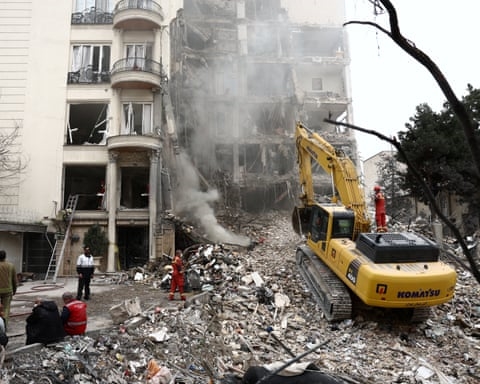
Israeli forces conducted a new series of strikes against targets in the Iranian capital, Tehran, even as the United States signaled a temporary halt to its own military operations against Iran’s energy infrastructure. The Israeli military stated its operations would proceed according to national directives until further orders are received.
The strikes commenced shortly after the U.S. administration announced a five-day extension to a deadline for potential attacks on Iranian power facilities, citing ongoing diplomatic discussions. Israeli military communications indicated the latest operation focused on infrastructure linked to what it termed Iran’s “terror regime.”
Military officials clarified that energy sites would not be targeted in these strikes, aligning with the reported U.S. pause on such actions. An Israeli military representative declined to comment directly on the U.S. diplomatic announcement, describing it as a matter for political leadership, and reaffirmed the military’s commitment to its operational plans.
Reports from the ground in Tehran described the scale of the explosions as significant. The Israeli defense establishment had recently warned that strikes against Iran and its supporting infrastructure would mark a serious escalation.
This latest Israeli action follows a claimed attack by Iran’s Revolutionary Guards on targets within Israel earlier in the week. Prior to the Israeli strikes, the U.S. administration characterized recent conversations with Iranian counterparts as productive, leading to the temporary suspension of strikes on energy targets.
The Israeli Prime Minister’s office has not issued an immediate statement regarding the U.S.-Iran talks or the specific U.S. decision.
In a separate operational update, the Israeli military stated it hit several military installations in Iran, including bases associated with the Revolutionary Guards, a missile production site, and other research facilities. These claims could not be independently verified.
A human rights monitoring agency reported numerous attacks across Iran in the preceding day, resulting in several casualties. Reports from within Iran indicate that a portion of the overall casualties in the conflict have been minors.
Cumulative casualty estimates since the onset of hostilities vary, with some figures reaching into the thousands. The Israeli military also reported progress in degrading Iran’s ballistic missile launch capabilities, claiming a significant reduction in the daily rate of missile fire into Israel.
Concurrently, Israeli military activity continued along the border with Lebanon. Strikes were reported in the southern suburbs of Beirut, an area with a strong presence of the Hezbollah group, which is backed by Iran. Israeli forces also announced the capture of two Hezbollah members in southern Lebanon. Lebanese authorities reported one fatality from the strikes.
Israeli officials called on residents to leave specific areas prior to the strikes in Beirut. Additionally, Israeli military engineering equipment was reported deployed near the Lebanese border.
In a related political development, a senior Israeli government minister publicly advocated for the annexation of territory in southern Lebanon, proposing a permanent shift of Israel’s northern border. This statement reflects expansionist views that have drawn criticism both domestically and internationally.