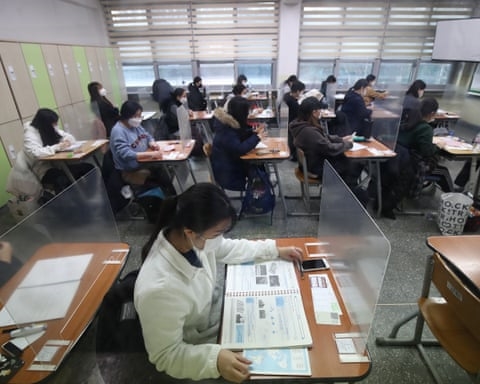
The official in charge of South Korea’s national university entrance exam has resigned in the wake of widespread criticism that this year’s English section was excessively challenging. The exam, a high-stakes event that can determine academic and professional trajectories, saw a record low number of top scores in the English component.
Official data indicates that only slightly more than 3% of test-takers achieved the highest grade in English this year, marking the lowest proportion since the current grading system was implemented. The exam questions, which students had 70 minutes to complete, included complex prompts requiring analysis of political philosophy, theoretical discussions on the nature of time, and abstract concepts related to digital existence.
The difficulty level sparked significant public debate in a nation where the exam is treated with utmost seriousness. National protocols, such as halting air traffic during the listening portion to ensure silence, underscore its cultural weight.
In a statement, the departing official expressed a “deep sense of responsibility” for the English section, acknowledging it did not meet the intended standards of the grading framework. He also offered an apology for the anxiety caused to students and families and for disruptions to the admissions process. The examining agency separately apologized, recognizing the criticism that the test’s complexity contradicted efforts to reduce academic pressure on students.
Further controversy arose from the inclusion of the obscure term “culturtainment,” a hybrid word whose creator, a UK academic, expressed surprise at its appearance in a high-stakes assessment, noting it is not in common usage.
The incident has renewed focus on the intense pressures within South Korea’s education system. In a related development, lawmakers recently passed legislation prohibiting private English academies from administering standardized tests to preschool-aged children.
The sensitivity surrounding exam results was further highlighted this week by news coverage of a prominent business heir, who gained admission to a leading university despite answering one question incorrectly, underscoring the fine margins and intense scrutiny associated with the test’s outcomes.