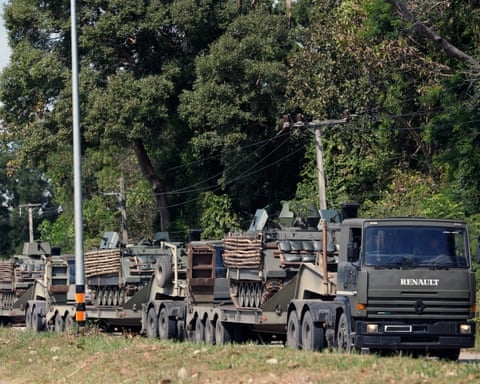
Reports of a renewed ceasefire agreement between Thailand and Cambodia have been directly contradicted by officials on the ground, where military engagements continue to escalate. Despite an announcement from a former U.S. president claiming both nations had agreed to halt hostilities, the situation at the shared border remains volatile.
Thai leadership has explicitly denied agreeing to any cessation of fighting. The country’s caretaker prime minister stated that military operations would persist until perceived threats to Thai territory and citizens are neutralized. In a related move, Cambodian authorities suspended all border crossings.
The latest violence, which reignited earlier this month, has resulted in significant casualties and displacement. Military sources report dozens of soldiers killed on both sides, alongside civilian deaths and injuries. The conflict has forced hundreds of thousands of residents from their homes in border regions.
The reported ceasefire was said to revive an agreement originally brokered last July with external mediation. However, statements from Thai officials dismissed the latest claim, expressing disappointment at what they characterized as a misrepresentation of the current situation. Cambodian leadership, while not directly addressing the ceasefire announcement, emphasized a continued pursuit of a diplomatic resolution based on prior accords.
The fighting involves advanced weaponry, including airstrikes and long-range rocket barrages, which have damaged civilian areas. The core of the longstanding dispute centers on contested border territories, a issue with deep historical roots tracing back to colonial-era maps and a mid-20th century international court decision.
International calls for de-escalation and monitoring proposals have been met with a mixed response. While one party has shown openness to external verification of which side initiated the latest clashes, the other has denied even entering negotiations on such a plan.
The ongoing conflict underscores the fragility of previous diplomatic efforts and the complex historical grievances that fuel the border tensions between the two Southeast Asian nations.