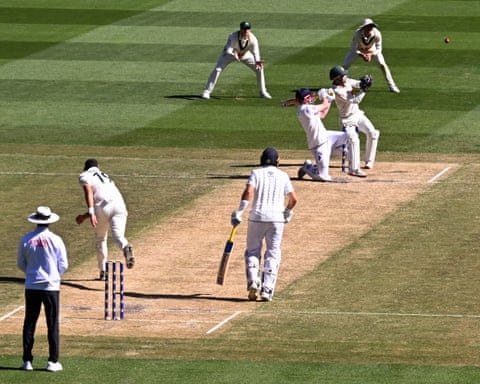
MELBOURNE — In a chaotic, two-day Test match at the Melbourne Cricket Ground, England secured a long-awaited victory on Australian soil, breaking a drought that stretched back to 2011. The win, however, served as a stark reminder of what might have been achieved on this tour, rather than a redemption for its overall failures.
The match was a spectacle of accelerated cricket. Chasing a modest target of 175 on a green, seaming pitch, England’s top order launched an assault that felt less like traditional Test batting and more like a frenetic, high-stakes exhibition. Ben Duckett set the tone with a bizarre, aggressive 34 from 26 balls, featuring air swings, bold ramps, and a dismissal that typified the madness. Zak Crawley provided a moment of clean striking, lofting a six, as the opening pair raced to fifty in under seven overs.
The arrival of Brydon Carse at number three, with over a hundred runs still needed, epitomized the disregard for convention. His brief, chaotic stay was a whirlwind of unorthodox shots, a far cry from the gritty, attritional cricket often demanded at the revered MCG—a ground treated here with something bordering on sporting sacrilege.
Ultimately, the approach worked. England reached their target with four wickets in hand, completing the chase at a breakneck rate. The victory was built on a superb bowling performance earlier on the second day, dismissing Australia for 132 despite being a bowler short.
This result is a significant achievement. Winning a Test in Australia has been a monumental challenge for England for over a decade, a period marked by collapses and heavy defeats. To do so with a depleted attack and on a difficult surface is a credit to the team’s spirit.
Yet, the triumph carries a bitter aftertaste. It functions less as a validation of the tour’s strategy and more as an indictment of its poor planning. It revealed an Australian side that was visibly vulnerable. Missing three frontline bowlers, with a fatigued attack and a brittle batting lineup, the hosts were there for the taking.
England, however, arrived undercooked. The tour began with a disjointed performance in Perth, a team seemingly unsure of its footing. What this Melbourne win demonstrates is that with better preparation and a more balanced squad, this series could have been genuinely competitive. Instead, a talented group of players has at times been let down by a regime that has struggled to translate a bold philosophy into consistent, winning execution.
The victory stands alone as a memorable feat. But it must also resonate internally as a rebuke—a frustrating lesson in how opportunities are squandered through complacency. As the series moves to Sydney, England may yet finish strongly. But the lingering question will remain: how different might this southern summer have looked if they had found this urgency from the very beginning?