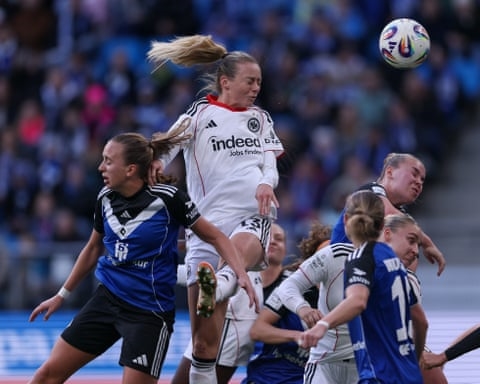
Germany’s top women’s football clubs are charting a new course, aiming to reclaim their place among Europe’s elite. In a decisive move, all 14 clubs of the Frauen-Bundesliga have united to form their own independent league association, effectively splitting from the German Football Federation (DFB). The goal is clear: to accelerate commercial growth and regain control over the league’s destiny, with a target launch for the new structure in the 2027-28 season.
The decision stems from a growing concern that German women’s football has lost ground to rapidly evolving competitions abroad, particularly England’s Women’s Super League (WSL). Katharina Kiel, newly elected president of the Women’s Bundesliga Association and head of women’s football at Eintracht Frankfurt, framed the move as essential for survival. “We faced a choice: evolve or be left behind,” she stated, highlighting how the commercial explosion surrounding events like the 2022 European Championship in England exposed a financial mismatch in Germany, where rising costs were not met by parallel revenue streams.
Under the DFB’s stewardship, clubs felt they lacked the autonomy to make swift, strategic decisions. “We were part of the structure but had no real power,” explained Bianca Rech, a director at Bayern Munich. The new model, inspired by the WSL’s successful transition, aims to place that power directly in the hands of the clubs. This will allow them to set their own rules on crucial matters like minimum salaries and infrastructure standards, while aggressively pursuing new sponsorship and media deals.
Officials acknowledge that Germany failed to fully capitalize on its past golden eras, including World Cup victories, allowing other nations to surge ahead. The upcoming 2029 European Championship on home soil is seen as a pivotal opportunity to correct that course. However, the transition will be methodical. The coming seasons will be used to build a robust and capable organization, ensuring the new entity is fully prepared to support the clubs commercially and competitively by the 2027 deadline.
Despite the current gap, there is a palpable sense of optimism. With historic clubs like Borussia Dortmund and VfB Stuttgart rising through the ranks, the league’s landscape is becoming more dynamic and increasingly mirrors the prestige of the men’s Bundesliga. The ultimate focus, as Kiel emphasizes, remains on the product on the pitch. “We want an attractive game,” she said. “Everything else must be aligned to support that.” While future collaboration with the DFB on specific topics remains possible, the message is unequivocal: the future of German women’s club football is now firmly in the hands of those who invest in it every day.